‘The situation now is the worst’ — Kyiv’s energy crisis deepens after Russia pounds power grid
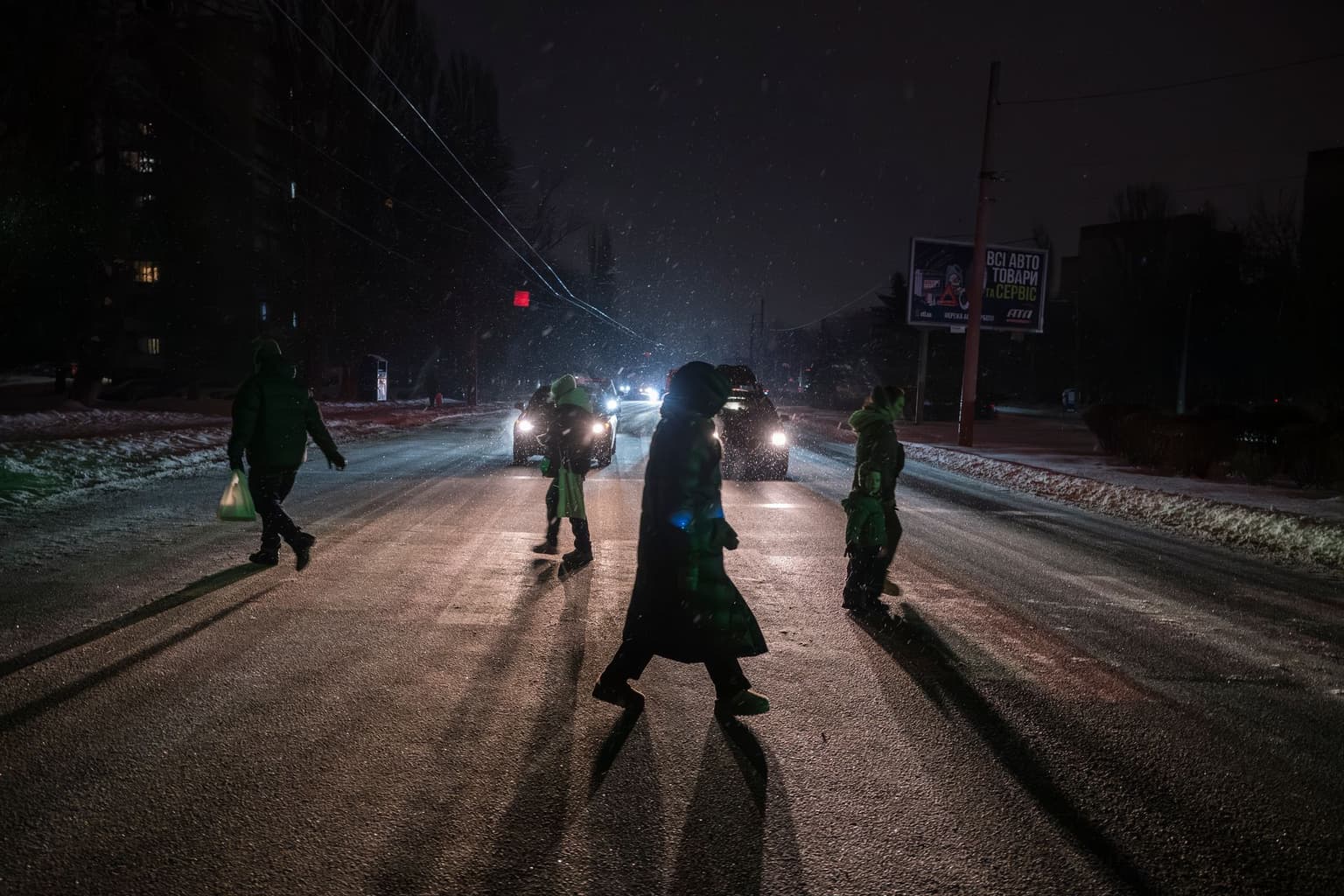
People cross a street during a power outage caused by recent Russian missile and drone attacks on critical civilian infrastructure in Kyiv, Ukraine, on Jan. 11, 2026. (Maxym Marusenko / NurPhoto via Getty Images)
 on Google
As Kyiv faces prolonged blackouts and subzero temperatures, officials and energy experts warn that the city's infrastructure is nearing its limits. Although the number of buildings without heat has decreased since the Jan. 9 mass missile and drone attack, the broader impact of the crisis on daily life is only deepening.
According to Kyiv Mayor Vitali Klitschko, about 800 residential buildings in the capital remain without heating as of Jan. 12 — a significant drop from the 6,000 buildings left in the cold following a massive overnight assault on Jan. 9 that targeted critical infrastructure and killed at least four people.
Klitschko's spokesperson, Oksana Zinovieva, told the Kyiv Independent that the mayor's Jan. 9 message was not an evacuation order but instead "a recommendation for those who can temporarily leave," to do so, given the ongoing energy crisis and extreme cold. She noted that the situation remains difficult.
"Especially with electricity, which directly affects heating and water supply systems," Zinovieva said.
A spokesperson for the Kyiv City Military Administration, Kateryna Pop, also clarified that no official evacuation order has been issued.
"Such a decision has not been agreed with the Kyiv City Military Administration and has not been adopted by the Kyiv Defense Council," she said, adding that the most difficult situation remains on the city's left bank.
Ukraine's Prime Minister Yuliia Svyrydenko confirmed on Jan. 12 that the worst-hit areas include Kyiv and Kyiv Oblast, particularly the Boryspil and Brovary districts.
"The top priority is to restore heat and electricity to all residential buildings," Svyrydenko said on Telegram. "Emergency services are working under freezing conditions, heavy ice, and near-daily bombardments."


Meanwhile, temperatures in Kyiv dropped to -16 celsius (3 degrees Fahrenheit) on the morning of Jan. 12, and weather forecasts indicate freezing conditions will likely continue for at least two more weeks.
'The situation now is the worst'
Energy experts say that while this may not be the most intense wave of strikes, its impact is among the most severe to date.
"Maybe this wasn't the worst attack, but this is the worst impact we've seen. Compared to all previous winters, the situation now is the worst," Olena Pavlenko, president of the Kyiv-based energy-focused think tank DiXi Group, told the Kyiv Independent.
Pavlenko explained that ongoing attacks over the past years have severely degraded Ukraine's energy infrastructure.
"Every time it's harder to recover. Everything is under ice, and repairs of cables and grids are now two to four times more complicated," she said.
Pavlenko also noted that Ukraine is lacking critical spare parts for combined heat and power plants, which Russia is specifically targeting. She emphasized that the government hasn’t let on how dire the situation is and called for better communication from the Energy Ministry.
"The Energy Ministry needs to be more open with people and with international partners. Silence is often seen as ignorance. Explaining what's happening would help restore trust and attract support and equipment we urgently need," she said.
The Energy Ministry did not respond to an inquiry from the Kyiv Independent by the time of publication.
Private energy providers also said that restoring power is growing more difficult.
"Functioning parts of the system are overloaded, and outages are the unavoidable consequence," DTEK, Ukraine's largest private energy company, said in a comment to the Kyiv Independent.


To address the challenges, Ukraine's State Emergency Service has established a dedicated energy response unit to assist during prolonged power outages, Interior Minister Ihor Klymenko announced on Jan. 12.
"In Kyiv, the State Emergency Service has deployed generators to supply temporary electricity to residential buildings where restoration is still ongoing. Additional generators were transferred from other regions to ensure a rapid response. A special Energy Unit has been formed for this purpose," Klymenko said.
The country’s state-run forest agency is constantly stocking warehouses with firewood as the situation deteriorates in preparation for "any scenario," the agency said in a press statement. So far, it has accumulated 220,000 cubic meters (about 7.8 million cubic feet) of wood – enough for citizens, the army, and civilian facilities.
Cutting energy links between east and west
According to Denys Sakva, an energy analyst at Ukrainian investment firm Dragon Capital, Russia appears to be targeting Ukraine's grid in a way that could isolate industrial regions from the country's main energy generation centers.
"They're trying to disconnect the industrially developed eastern areas like Dnipro and Zaporizhzhia from the right bank, where most of the power generation is located," Sakva told the Kyiv Independent.

The left bank, including parts of Kyiv and much of eastern and southeastern Ukraine, has very limited generation capacity due to constant Russian strikes. Electricity from the right bank must be transferred across the Dnipro River using high-voltage substations operated by Ukrenergo, the state-owned grid operator, many of which have been deliberately targeted for destruction.
"It's getting harder and harder. When a power plant is hit ten times, repairs take longer each time. Spare parts run out. You can't cannibalize from other plants forever," Sakva said.
He also noted that Russia now has thousands of drones and far more experience in targeting Ukraine's grid than it did in 2022, making recent attacks more damaging.