Iran oil price shock fuels Hungary's campaign against Russia sanctions
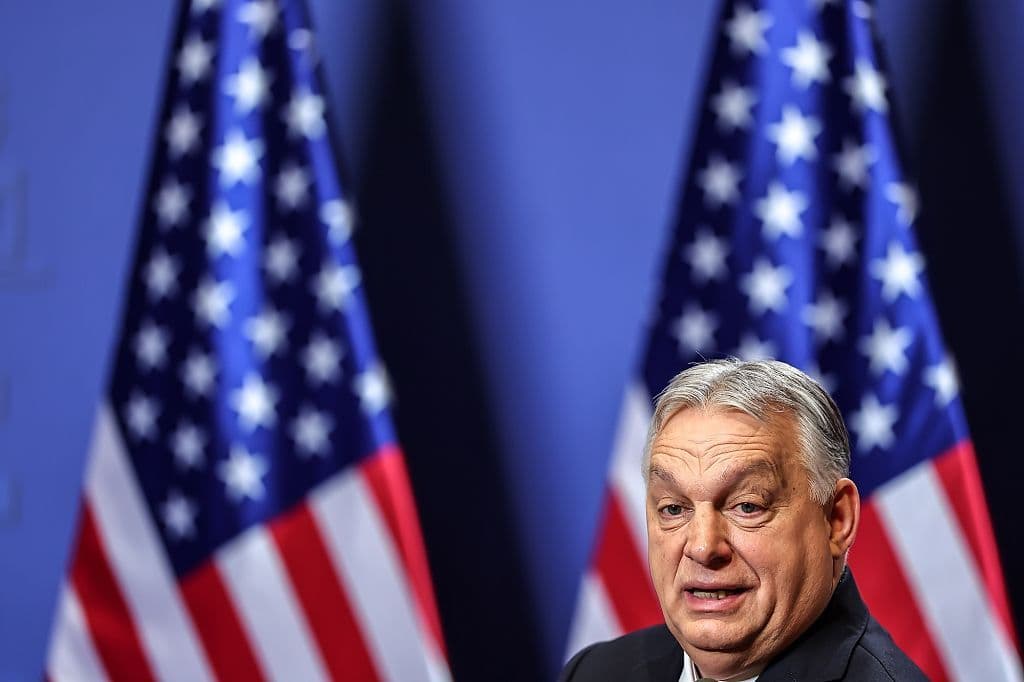
U.S. Secretary of State Marco Rubio (L) gives a press conference with Hungary's Prime Minister Viktor Orban during a visit to Budapest, Hungary, on Feb. 16, 2026. (Robert Nemeti/Anadolu via Getty Images)
 on Google
Editor's note: The story has been updated with the latest developments.
The joint U.S.-Israel attack against Iran just gave Hungary fresh ammunition in its crusade against the EU sanctions on Russia.
In the wake of Israeli attacks against Iranian oil facilities and the effective closure of the Strait of Hormuz, global oil prices briefly climbed above the $100‑per‑barrel mark for the first time since 2022.
Hungary's leader Viktor Orban urged the EU on March 9 to lift sanctions on Russian energy, arguing that the Middle East conflict and a purported "Ukrainian oil blockade" sparked an "explosive" price spike in his homeland.
Amid an escalating dispute with Ukraine over the suspension of the Druzhba pipeline and a tight election race at home, the Hungarian leader is increasing pressure on Brussels.
"We must review and suspend all sanctions on Russian energy across Europe. I initiated this today in a letter to (European) Commission President (Ursula) von der Leyen," Orban said in an address on Facebook.
As the EU looks to phase out Russian energy by the end of 2027, the new round of fighting in the Middle East is putting its resolve to the test.
"The nervousness in Brussels and across the globe is very real, and that is exactly what Moscow is counting on," Alexander Kirk, a sanctions campaigner at the NGO Urgewald, told the Kyiv Independent.
Europe braces for energy shocks
As the week began, Brent crude prices jumped to nearly $120 before easing again after U.S. President Donald Trump declared the war in Iran is "very complete."
European gas prices also spiked, with benchmark natural gas futures rising up to 30%.
The development comes as trade through the Strait of Hormuz — a narrow passage that transits about 20% of global oil and liquefied natural gas (LNG) shipments — is effectively blocked.
With Iran and Israel trading fresh strikes and Mojtaba Khamenei, son of the slain Ayatollah Ali Khamenei, assuming power in Tehran, it remains unclear whether the conflict truly nears its end as Trump claims.
Experts warn that a prolonged conflict in the Middle East would be an economic boon for Russia, a major fossil fuel exporter.
Oil and gas sales account for about one-quarter of Russian federal tax revenues and play a key role in sustaining its war on Ukraine, which is why the EU aims to end Russian energy imports by the end of next year.
The European Union has drastically reduced imports of Russian oil since the all-out war started. Pipeline oil imports were prohibited, with Hungary and Slovakia the only two members still permitted to purchase Russian crude via the Druzhba pipeline.
TurkStream remains the only operational route for Russian pipeline gas to Europe. However, purchases of Russian liquefied natural gas (LNG) have increased during the war, with the EU the leading buyer in 2025.
Hungary and Slovakia have opposed an EU-wide phase-out and repeatedly obstructed sanctions — and now have a fresh argument to back it up.
"There will be a lot of pressure on the EU's plan to phase out Russian oil and gas, especially the TurkStream pipeline," Ben McWilliams, affiliate fellow at Bruegel, told the Kyiv Independent.
Nevertheless, Kirk warns that easing sanctions would not fix the problem for Europe.
"Russia's shadow fleet means any relaxation is unlikely to translate into meaningful new supply hitting global markets," the campaigner said.
"The tools to manage this crisis without retreating on Russia exist. Reserve releases, accelerated renewables, diversified supply. There is no trade-off between market stability and sanctions discipline. Only a failure of political will to pursue both."
Orban renews push
Hungary and Slovakia, both landlocked European countries, have long argued that a halt to Russian supplies threatens their energy security.
Now, Orban can "extend the argument to the whole EU," says Andrej Nosko, a Central European energy policy and security expert at Matej Bel University in Banska Bystrica.
"Should the blockade of Hormuz last longer, it may also affect the LNG market and put double-pressure on the EU," Nosko told the Kyiv Independent.
As most of Hungary's gas comes from Russia via the TurkStream pipeline, Budapest has another reason to oppose EU sanctions.
"Hungary doesn't import gas through TurkStream at global prices; they have some favorable terms — although they are not public, so we don't know exactly how much they pay," McWilliams commented.
This means that Hungary is "getting gas at a price which is much cheaper than if they had to go to global markets right now," he added.
"As LNG gets more expensive, the Turkstream is an easy political target for Orban, who can blame the EU for rising energy prices."
Much like the rest of Europe, Hungary has felt the impact of the latest price shocks.
Gasoline and diesel fuel prices in the country continue to climb, a development compounded by the dropping value of the Hungarian Forint.
As Hungarian fuel costs track stock exchange quotes, the surge in crude is likely to spill over into the domestic market as well, Nosko says.
But unlike the rest of the EU, Hungary and Slovakia are simultaneously caught in another energy conundrum: the halt of Russian crude supplies via the Ukrainian section of the Druzhba pipeline.
Druzhba dispute
Roughly 86–92% of Hungary's crude oil imports and almost the entirety of Slovakia's supply have been flowing via the southern branch of the Druzhba pipeline.
Transit has been suspended since late January due to a Russian attack in western Ukraine, Kyiv said. Budapest and Bratislava accused Ukraine of deception, claiming it is deliberately withholding the supplies for political reasons.
Recent weeks have seen Orban adopt increasingly combative rhetoric toward Ukraine, prompting similarly harsh pushback from Kyiv.
Analysts have linked this development to Hungary's upcoming April parliamentary elections, where Orban's Fidesz party trails the opposition Tisza party in polls.
With the economic ripples of the war in the Middle East in full swing, Orban seems unlikely to relent.
Luca Léry Moffat contributed reporting.
read also
 Luca Léry Moffat
 Kollen Post
Note from the author:
Hi, this is Martin Fornusek.
I hope you enjoyed this article. In our team, we believe fact-based and truthful reporting should be available to all — that's why we don't use any paywall.
If you'd like to help us provide you with more in-depth coverage of Ukraine's struggle against Russian aggression, European politics, and other topics, please consider joining the Kyiv Independent community.