'No one thought we would get out alive' — the audioguide memorializing one village's Russian occupation
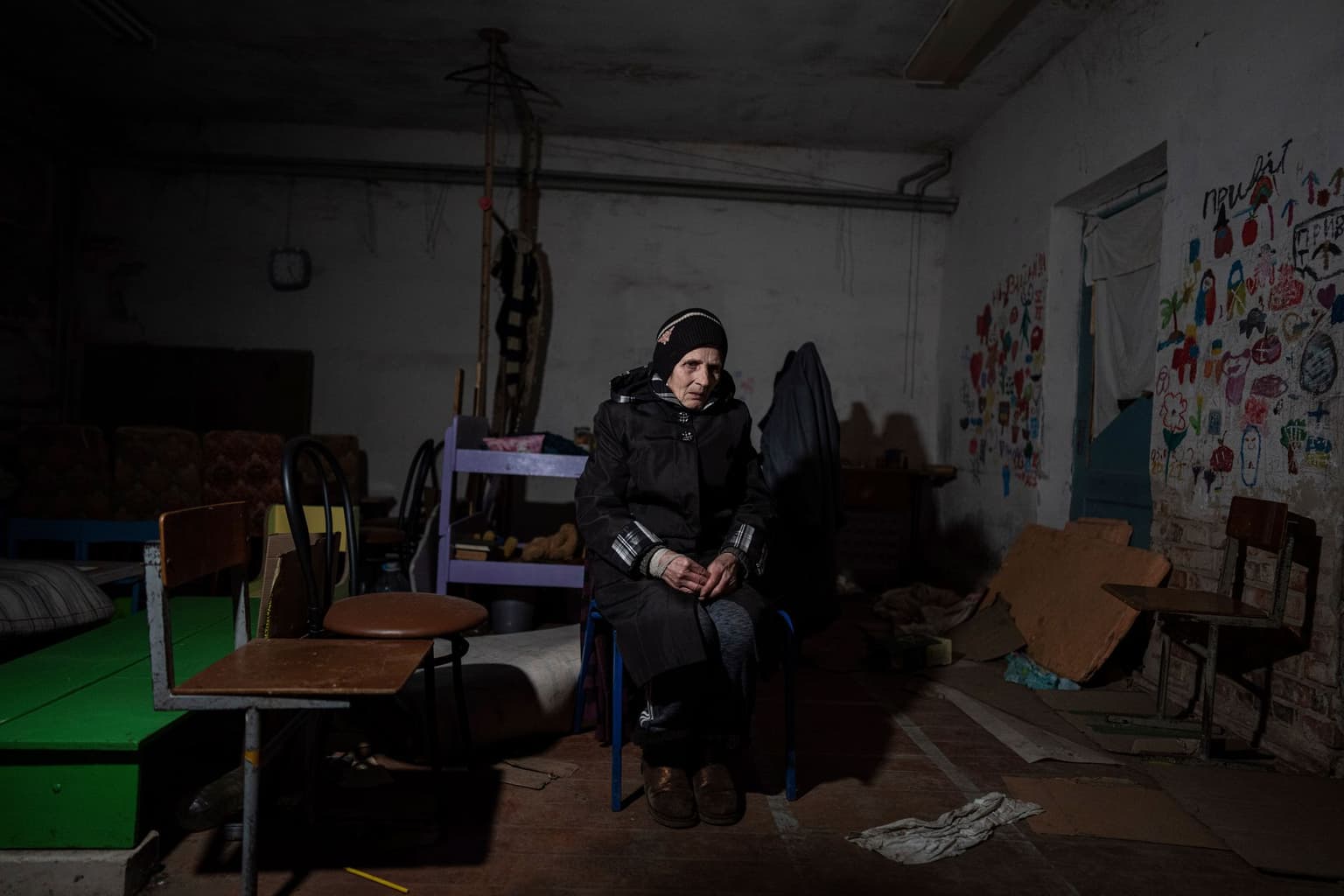
Valentina Saroyan sits in the basement of a school in Yahidne, Chernihiv Oblast, Ukraine, on April 12, 2022. (AP Photo/Evgeniy Maloletka)
 on Google
YAHIDNE, CHERNIHIV OBLAST – The unkept school stands still, surrounded by pine and birch trees covered with melting snow. Shattered windows remain, and the voices emanating from the audioguide bear witness to the torment of the ordeal inflicted upon the villagers by Russian occupation.
Russian troops captured Yahidne village in northern Chernihiv Oblast on March 3, 2022.
All the civilians who could not escape the village in time were trapped — Russian soldiers forced all, from infants to the elderly, into the school cellars, to create a human shield and set up a base on the school's upper floors.
A total of 368 people, including nearly 80 children, the youngest only six weeks old, were packed into a basement with six rooms. There was barely any food or water. Instead of toilets, they used buckets.
Ten people died during the ordeal. Another seven people were executed by Russian forces in the surrounding village, including Ukrainian journalist Roman Nezhyborets.

"No one thought we would get out of the basement alive," school janitor Ivan Polhui, who guarded the same school before the occupation and survived almost one month in the basement, told the Kyiv Independent.
"We dug a hole and thought it was for ourselves," he added, referring to the days when they were allowed to bury those who died in the basement at the mass grave in the cemetery a ten-minute walk from the school.
Those who survived 27 days with little food and water could barely believe it when they saw their city liberated at the end of March 2022.
"For our village, this was the end of the war," Valentyna Danilova, a retired teacher, said.
To hear their voices
Four years later, that basement in Yahidne is now a museum piece of sorts, exhibiting just one of the countless atrocities committed by Russia in Ukraine. Visitors can see children's drawings on the walls, breathe the stale, suffocating air, and even listen to an audioguide woven together from eyewitness testimonies.
The Public Interest Journalism Lab developed the audio guide "Yahidne: A Village in Captivity" based on testimonies recorded by the Reckoning Project, a global initiative for documenting war crimes.

It was released on March 2, 2026, and since then, everyone can access the memories of the Yahidne community. It's not necessary to be in the village to appreciate the story, as it is narrated well enough to create a vivid picture in one's mind without being physically present at the site of the tragedy.
The guide is available in two languages — Ukrainian and English. The latter is narrated by historian Timothy Snyder, with the voices of residents dubbed by historian Marci Shore, journalist Anne Applebaum, journalist and researcher Peter Pomerantsev, politician Chrystia Freeland, journalist Sabra Ayres, and writer Jonathan Littell.
Memorialisation while the war is ongoig
Lyuba Knorozok, a film and media producer with the Reckoning Project, told the Kyiv Independent about the importance of documenting and memorializing the testimonies now, even though the war is still ongoing.
"We have a unique opportunity to do this while military actions are in action, because we don't know which of the descendants of this memory will survive (till the end of the war), will remember it, and so on," she said.
Yahidne has become a frequent destination for various foreign organizations and politicians, as it is just 140 kilometers (85 miles) from Ukraine's capital. President Volodymyr Zelensky visited Yahidne several times during the full-scale invasion.


Knorozok believes that the audioguide is more "sustainable" for survivors because they are not compelled to recount their traumatic experiences multiple times for different delegations and guests — instead, everyone can listen to the recorded audio.
The Yahidne community is actively involved in preserving the memory of their shared trauma and the period of occupation. Public Interest Journalism Lab held several meetings with the community to discuss an appropriate way to memorialize the atrocity. For Yahidne residents, the memory of the tragic occupation is not only a shared trauma, but also a record and proof of Russia's war crimes.
In addition to an audio guide, a museum is also planned in Yahidne. Construction has already begun, although it has not yet been decided what exactly will be inside the museum.

Life goes on in the community
From time to time, Russian Shahed-type drones fly over Yahidne — a constant reminder that the war continues.
Despite the ongoing war, Yahidne residents continue to live and pass down their memories. Houses, damaged by Russian soldiers living and looting there, have been restored, and solar panels mounted on poles are visible above the treetops.
Tamara Klymchuk, a retired resident whose house was also destroyed during the occupation, moved into her renovated house a month ago.
"I want to live a little longer in warmth and beauty," she said, while her new puppy jumped around her feet.

Valentyna Danilova has been working with therapists after her imprisonment in the basement. She feels better now, though occasional news-related anxiety still resurfaces.
"It seems everything (bad) has passed, and I really don't want it to come back again," Danilova said.
Despite ongoing threat from Russia, both Klymchuk and Danilova hope they have left their worst days behind in that basement.
On March 11, 2024, the Chernihiv District Court sentenced 15 Russian soldiers who committed war crimes against residents of Yahidne. They were convicted in absentia under Articles 28 and 438 (Part 1) of Ukraine's Criminal Code, for violating the laws and customs of war.
read also
 Natalia Yermak
 Natalia Yermak
 Tania Myronyshena