3 glaring issues with the UK-France peacekeeper troops plan for Ukraine
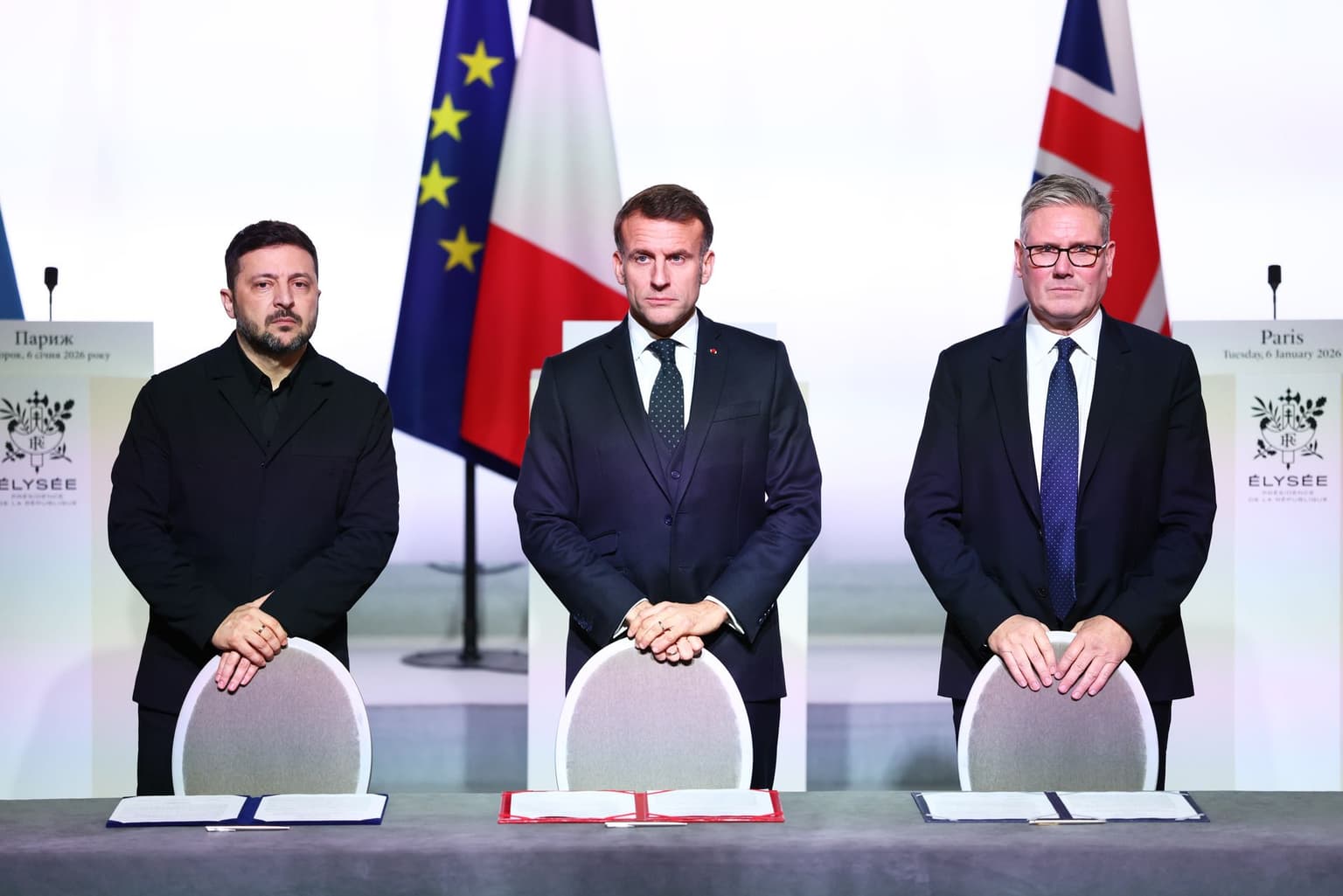
President Volodymyr Zelensky, French President Emmanuel Macron, and British Prime Minister Keir Starmer sign a declaration at the Élysée Palace in Paris, France, on Jan. 6, 2026. (Tom Nicholson / Getty Images)
 on Google
In a grandly-staged, and much publicized meeting on Jan. 6, Ukraine and its Western allies celebrated a deal that would pave the way for French and British peacekeeping troops to deploy in Ukraine — once the war is over, of course.
French President Emmanuel Macron said "considerable progress" had been made. U.S. Special Envoy Steve Witkoff said work on agreeing security protocols was "largely finished." And President Volodymyr Zelensky said it was a "huge step forward."
But there were several elephants in the room.
"All of this is supposed to be after peace, but there is absolutely nothing to suggest that peace, in any recognisable form of the word, is anywhere near," Keir Giles, a senior consulting fellow at Chatham House, a U.K.-based think tank, told the Kyiv Independent.
1. That final 10%
Kyiv and Washington have on several occasions in recent weeks declared that 90% of the U.S.-backed peace deal is ready, which, on the face of it, sounds like an encouraging completion rate.
But Oleksiy Melnyk, co-director of foreign policy and international security at the Kyiv-based think tank Razumkov Center, used a curious but vivid metaphor to demonstrate that context is key when talking about completion rates.
"If you build something, 90% is quite a satisfactory result. In other cases, if we talk, for instance, about childbirth, it's either 100% or nothing," he told the Kyiv Independent.
"And the remaining 10% could destroy the whole peace deal if it's not achieved."
There's a good reason why that last 10% is still to be finalized, as it covers two of the most intractable points of disagreement between Ukraine and Russia — territory, and control over the Zaporizhzhia Nuclear Power Plant.
"The idea of a Western "reassurance force" in Ukraine is welcomed, as much it is rejected in Russia."

Ukraine's baseline position on territory is to remain where its forces are currently deployed. Moscow, by contrast, is demanding that Ukraine pull troops out of parts of Donetsk Oblast that Russian forces have failed to capture.
As for the power plant, a U.S.-backed framework proposed the plant would be operated jointly by Ukraine, the United States, and Russia, with all three parties sharing economic benefits.
But Ukraine fears that a trilateral management model would effectively legitimize Russia's occupation of the facility, and is instead proposing a bilateral alternative: a joint Ukrainian–American enterprise with equal operational control.
And despite the fanfare of recent announcements, there's been next to nothing proposed on how to overcome these two issues in a way that could result in a peace deal.
2. The 'strategic paradoxes'
Compounding the intractability of the final 10% is the fact that the announcement of a U.K.-France peacekeeping force actually makes reaching a peace deal more difficult.
"The current public discussions about Western troop deployment in Ukraine are counterproductive to the negotiations between Russia and Ukraine on a ceasefire," Andreas Umland, associate professor of political science at the National University of Kyiv-Mohyla Academy, wrote in an op-ed for the Kyiv Independent.
"The idea of a Western "reassurance force" in Ukraine is welcomed, as much as it is rejected in Russia," he writes.

"If Europe promises to bring in troops only after the war ends, it will likely decrease Moscow's readiness to agree to a ceasefire, thereby increasing the economic and military pressure needed to persuade the Kremlin to agree to a truce."
European troops on Ukrainian soil have consistently been one of Moscow's red lines, and there is nothing to suggest they will budge.
"The Americans may have shifted a little in terms of what they will entertain and support in terms of European intervention in the conflict. The Russians certainly have not," Giles said.
3. Not enough troops
The declaration announced on Jan. 6 includes five components: a multinational force tasked with strengthening Ukraine's Armed Forces and helping to ensure security "in the air, at sea and on land," U.S.-led ceasefire monitoring, support for Ukraine's military, binding commitments to back Kyiv in case of a future Russian attack, and long-term defense cooperation with Ukraine.
But precise details on the peacekeeping force were conspicuously absent.
"It is so incredibly vague that it's hard really to give any meaningful comment," Giles said.

In an interview with Talk TV on Jan. 7, former U.K. Security Minister Tom Tugendhat said that out of around 70,000 troops in the British Army, "fewer than 10,000" are deployable at any one time.
"You've got hundreds of miles (in Ukraine) to guard. The maths just don't add up. And I know we're supposed to be doing this with France, but France hasn't got a much bigger army," he said.
What should Europe be doing?
"There are things that should have been worked out in great detail and should have happened a long time ago, like Sky Shield, for example," Giles said.
Calls to "close the skies" over Ukraine — the rallying cry of pro-Ukraine demonstrations in early 2022 — resurfaced again last year after a wave of Russian airspace violations against NATO members.
"The easiest way to protect Ukraine's skies would be to extend the European Sky Shield Initiative, a project to create an integrated European air defense network first established in 2022.
An extension dubbed European Sky Shield for Ukraine was proposed in March of last year. According to the plan, developed by former British Air Force planners in cooperation with Ukraine's Armed Forces, the protection zone would cover Ukraine's three operational nuclear power plants, as well as the cities of Odesa and Lviv in Ukraine's south and west.
Establishing such a safe zone would not only restore stability and enable economic recovery but also allow Ukraine’s Air Force to focus on defending the eastern front.
The plan remains inactivated.
read also
 Asami Terajima
 Francis Farrell