Inside Russia's everyday manhunt of Ukrainians in Kherson
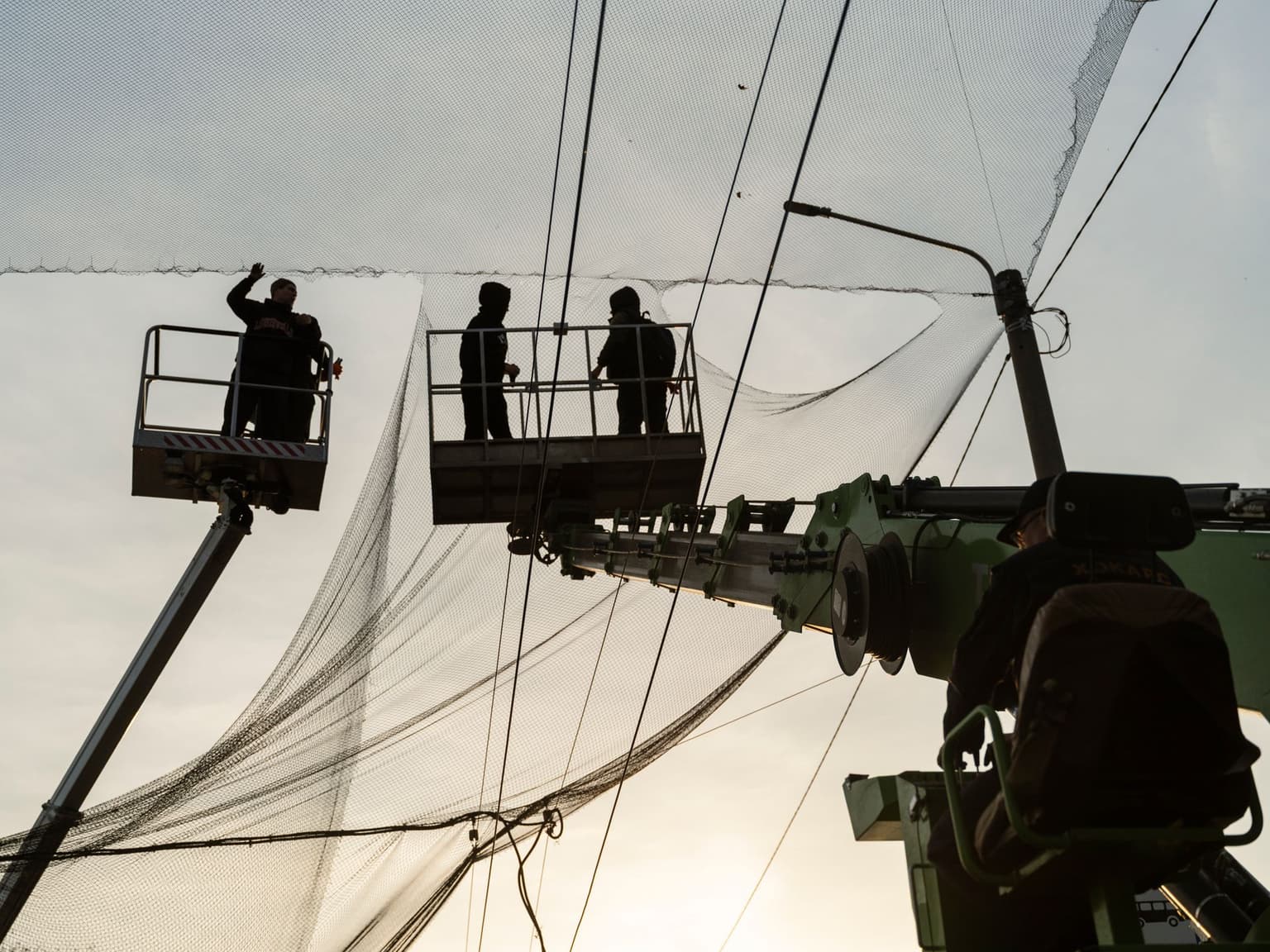
Workers install anti-drone netting over a street in Kherson, Ukraine, on Nov. 21, 2025. (Sasha Maslov / The Kyiv Independent)
 on Google
At the moment the grey mass of radio static gives way to a clear image on the drone detector screen, the hunter still seems deceptively far away.
Looking down on the central neighbourhood of Kherson from a bird’s-eye view, it remains unclear where the Russian drone is coming from or who it is stalking.
Catching the analog radio signal of the first-person-view (FPV) drone’s video transmitter, the detector shows exactly what the Russian pilot sees through his goggles as he flies from the occupied side of the Dnipro River.

The drone closes the distance quickly. Within 30 seconds, the shrill scream of four high-speed propellers can be heard over Freedom Square. At the sound, most of the few residents out in the open shuffle quickly to take cover. A mother and child duck into a purpose-built concrete bomb shelter beside a bus stop. Others do not react at all.
The video feed on the detector cuts off just as the drone descends to the level of the five-storey buildings around the square. A few seconds later, an explosion is heard. Afterward, seeing the threat has passed, locals emerge from cover and continue on their way.
The scene is just a snapshot of a grim and terrifying reality for Kherson's residents — they are target practice for Russian drone operators, honing their skills before they are sent into the heavy fighting in Ukraine's east.
"It's pure sadism," Dmytro, a Ukrainian commander of an electronic warfare unit defending the area, told the Kyiv Independent.
"Their pilots fly into the city, and if they don't see a military car, any car, or person, will do for them as a target, including civilian cars or ambulances."
Manhunt
Freedom Square in the centre of Kherson has been at the heart of the city’s dizzying journey through the full-scale war.
In the first days after Russian troops occupied the city in March 2022 — the only regional capital successfully seized in the initial invasion — local residents gathered en masse for weeks, protesting the occupation before being dispersed with tear gas and gunfire.
Eight months later, when Ukrainian troops liberated the city in one of the emotional high points of the war for Kyiv, thousands once again flocked to the square. They embraced Ukrainian soldiers and walked the streets without fear, some carrying flags they had hidden throughout the occupation.


Now, over three years since liberation, Kherson has descended into an unimaginably grim new reality.
With Russian troops still just on the other side of the river, the city is frequently bombarded with artillery, rocket fire and glide bombs, several of which have turned the regional administration building on the square into a gaping ruin.
But in developments even more terrifying, since summer 2024 and escalating with every month, the city is now known as the place where civilian residents — men, women, children and the elderly — are systematically and deliberately hunted by Russian high-precision drones.
This cynical, everyday war crime, is known by locals and the world alike as the "human safari."
In the year and a half since the human safari began in earnest, Russian drone teams flying increasingly advanced systems into Kherson and the neighboring villages have grown exponentially in number — and so have Ukrainian civilian casualties.

Over 2025, 3,152 total civilian casualties, including 332 deaths, were recorded in Kherson Oblast, according to international open-source intelligence project Tochnyi, which has extensively tracked and mapped the human safari since it started.
A total of 384 more casualties in the region since 2024 have come amongst first responders, often the victims of double tap attacks.
On the ground and in the air, Ukrainian soldiers, together with local authorities, work around the clock to protect the city from a threat never before seen in world history.
Meanwhile, the remaining residents of Kherson — numbering around 50,000 as of early 2026 — who have already lived through Russian occupation and years of bombardment, hold on to their homes and do their utmost to live normal lives under totally abnormal conditions.
Nets
Driving into Kherson on the main road from Mykolaiv, a scene opens before the eyes that looks straight out of a dystopian movie.
An entire highway, covered from end to end by a continuous tunnel of anti-drone nets, snaking across the barren southern steppe.
At its entrance, a lonely traffic light, not to control an intersection, but to warn drivers of Russian drones detected in the air.
The urgent need to cover the highway came in summer 2025, when the road was first targeted by Russian drones. Just like that, the heroic city, which had been through so much, was under threat of having its only lifeline cut off.
Now, the highway is covered, although drivers still prefer not to take their chances, speeding through the tunnel into Kherson as fast as conditions allow.
This morning is rainy and foggy, perfect for making the trip in and out.
Meanwhile, the work to protect Kherson's residents inside the city is only getting started.
Every day, teams of workers cover more and more of the city’s central streets with anti-drone nets in an effort run and managed by the regional administration.

Falling leaves, snow, and other debris weighing down on the nets create an ominous canopy from above.
Nets with larger openings are installed on the sides to catch FPVs, said regional administration official Olha Maliarchuk at the site where new nets were being erected. But for the roof of the tunnel, the nets needed to be thicker, to protect from small drone-dropped bombs.
"Our approach is uniquely conscious," she said. "We have figured out a system not only of installing, but maintaining the nets, and are ready to ramp up the scale of coverage."
Now, following the example of Kherson, regional administrations across front-line regions of Ukraine are covering major roads and city streets with the netting.
For now, Maliarchuk said, the battle for the highway has been won, with Russia largely abandoning attempts to penetrate the net tunnel. A grim victory, but a crucial one for keeping Ukraine's largest front-line city on its feet.
Escape
A tip-off from the military late in the afternoon leads to an intersection in a sleepy, low-density neighborhood just outside the red zone.
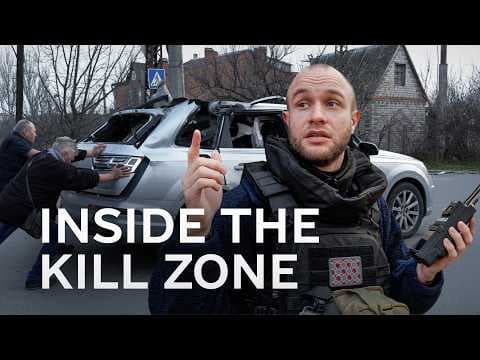
In the middle of the road is a newish silver Audi SUV that won’t be doing any more driving. The car’s roof is pierced and caved in, the windscreen and side windows shattered, and the rear mangled beyond recognition by a Russian FPV drone strike just about an hour prior.
The two occupants of the car, lucky to make it out alive, are in the hospital with concussions and minor injuries, said the military contact — just the latest victims of one of Russia’s most terrifying everyday acts of cruelty.
While attacks on Ukrainian civilians on the streets are also frequent, vehicles remain the favorite target of Russian hunters.

Many of the drone videos posted on Russian Telegram justify the indiscriminate strikes by claiming that the Ukrainian civilians inside are actually combatants.
Getting around in a passenger vehicle only becomes more deadly with the coming of darkness, with Russian car headlights making vehicles easy to spot by Russian night vision FPVs.
Bystanders try to put the car in neutral and remove it from the road, but it doesn’t budge.
“The only thing that saved them was how fast they were going,” said one of the bystanders who witnessed the FPV fly head-on into the car.
“If they hadn’t gone so fast, the drone wouldn’t have overshot its mark and collided straight with the windscreen.”
Locals warn against hanging out in the area for too long, as one drone attack is often followed by another — known as a double tap — against those who gather in the area.

Victims
Mortars, glide bombs, artillery, rockets, missiles, mines, FPV and bomb-dropping drones, snipers; located so close to Russian positions, Kherson is in range of almost every weapon in the Russian arsenal.
The diverse array of arms used against the city leaves its stamps on its residents in the form of a diverse array of wounds.
In one of the main city hospitals, a drab room branching off the main corridor houses two such victims of Russian attacks.
"A friend and I were heading to the store when a drone caught sight of us and dropped a bomb."
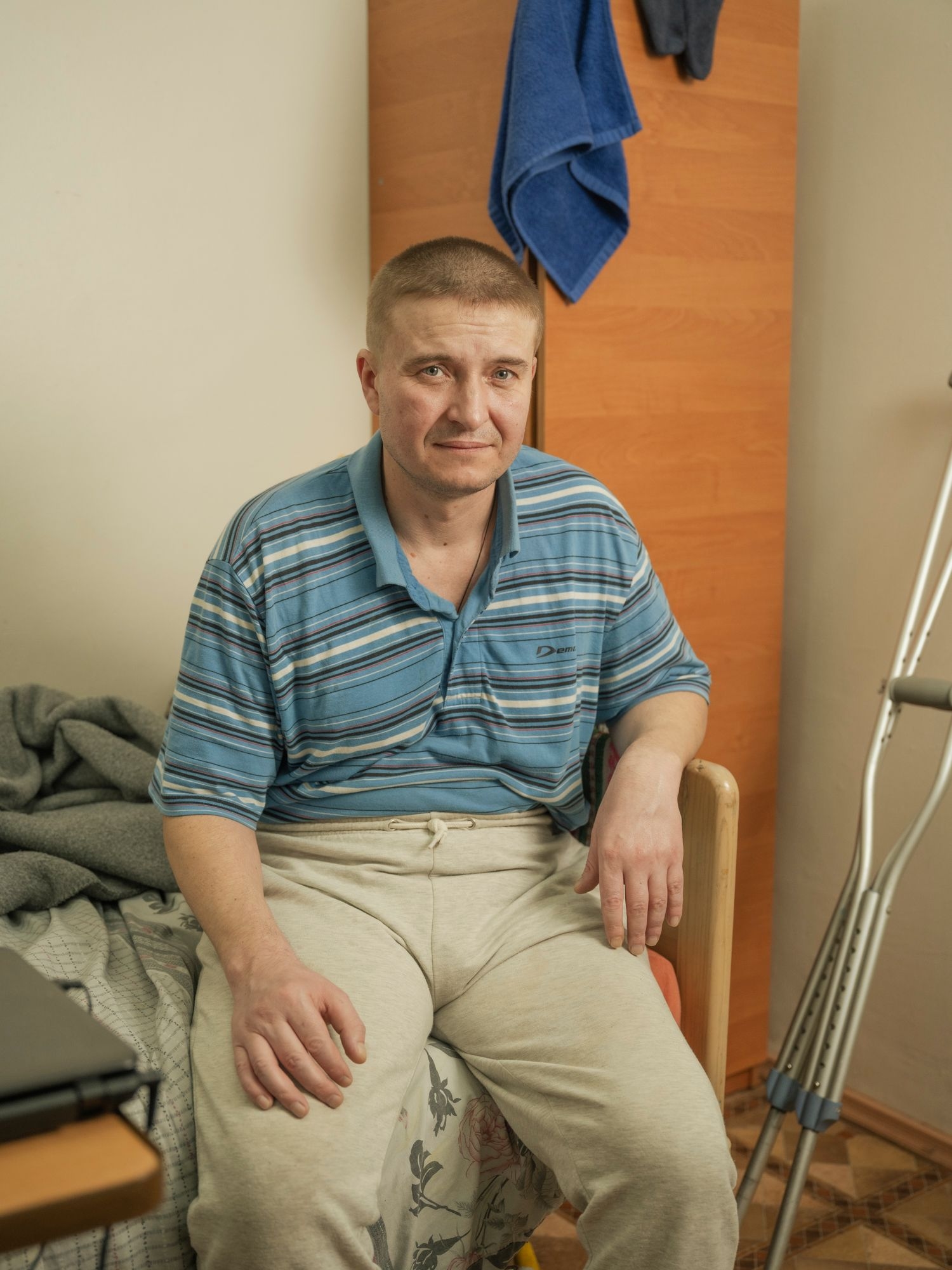
Serhii Shevchenko is treated in a hospital in Kherson, Ukraine, on Nov. 22, 2025. (Sasha Maslov / The Kyiv Independent)
What brought 36-year-old Serhii Shevchenko was a drone-dropped bomb: most likely the kind of Chinese model used across the front line for front-line reconnaissance thanks to their high-definition cameras.
"A friend and I were heading to the store when a drone caught sight of us and dropped a bomb. Two messed up legs, heaps of blood," he recalled in bed, applying cream to his swollen, badly scarred foot.
"They see anyone, a man, woman, or grandmother, and they drop their bombs. Why do they hunt people like that? I don't have an answer."
Distraught and with limited mobility while he heals, Shevchenko at least has hope of returning to something resembling normal life. His roommate, 53-year-old Volodymyr Baidarov, was less fortunate.
A resident of Antonivka — a low-density Kherson suburb near the now-destroyed Antonivskyi Bridge across the Dnipro River and now the most dangerous part of the city — Baidarov was running an errand when he stepped on an anti-personnel mine, of the type routinely spread by Russian drones.
"If they had gotten to me quicker, the leg could have been amputated below the knee."
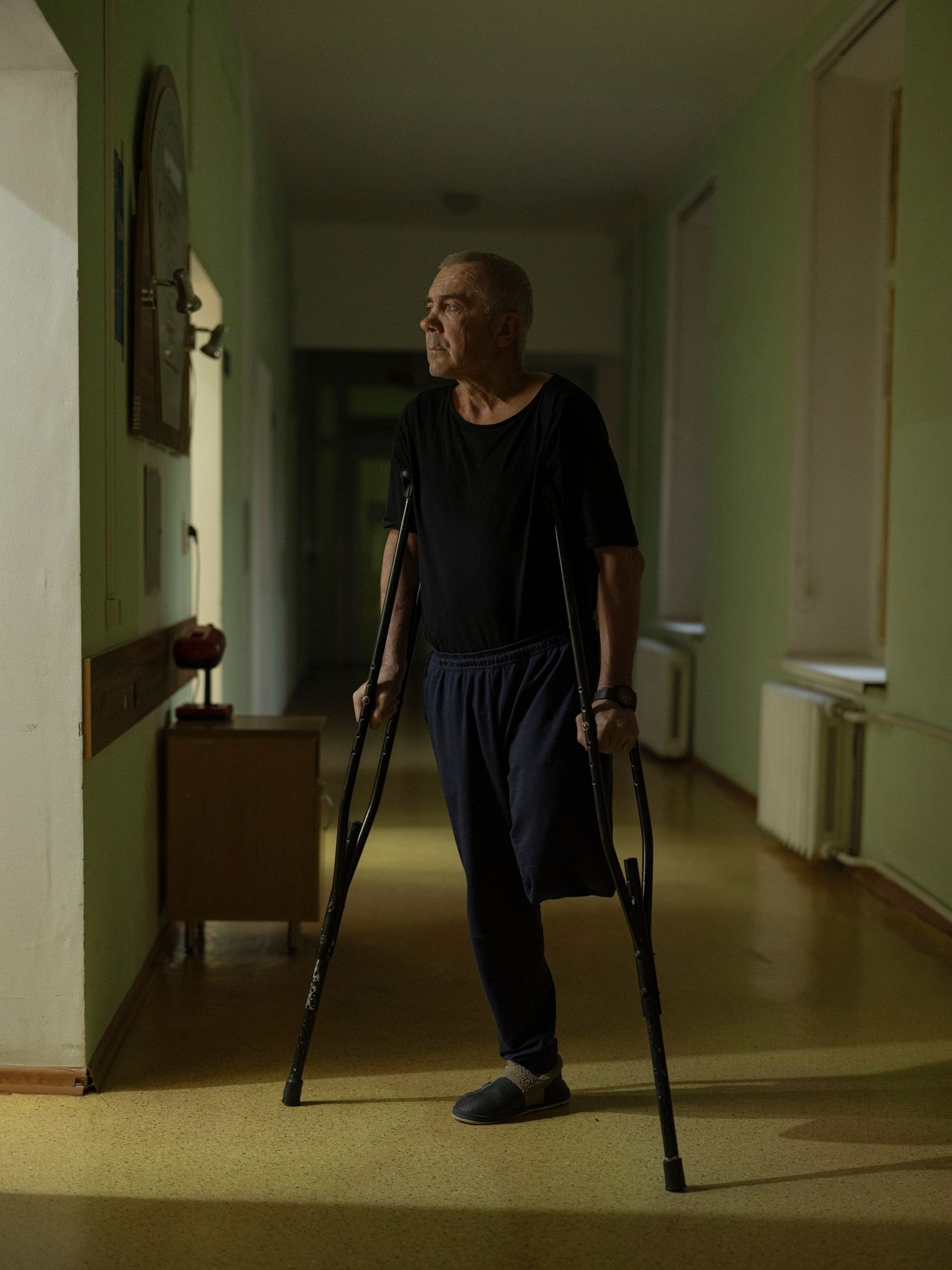
Volodymyr Baidarov in a hospital in Kherson, Ukraine on Nov. 22, 2025. (Sasha Maslov / The Kyiv Independent)
"There it was in the grass, I didn't see it, and stepped on it," he said.
"The blood was spraying everywhere."
Thinking fast, Baidarov used a piece of wire as an improvised tourniquet to stop the bleeding.
Reaching a friend's house, they called an ambulance, but with the rate of strikes on emergency workers in the area, he was told he had to make it out of Antonivka himself.
"If they had gotten to me quicker, the leg could have been amputated below the knee," he said.
"But nobody wants to go there, everyone is afraid."
Guardians
Along a dirt road through a field outside Kherson, a white car is seen through the shaky static picture of an approaching drone's camera.
The camera draws closer and closer, in what looks like the prelude to just the latest evidence of an attack on a civilian vehicle in the region. But at the last moment, the drone swerves off course, landing harmlessly in a field.
The footage plays on the phone of Dmytro, the commander of Ukraine's 310th Separate Electronic Warfare Battalion, part of the country's Marine Corps.

With a dense, high-tech array of sensors, detectors, and jamming devices, his unit defends the people of Kherson from Russia's human safari around the clock.
At the beginning of 2025, around 50-60 Russian drones would fly into Kherson per day, but by the end of the year, the average passed 300.
In his time in charge of the city's defense, Dmytro has been an indirect witness to countless murders of Ukrainian civilians.
"In spring 2025, we had cases where they were heavily targeting the coastal villages with bomb-dropping drones," the commander recalled, "they saw a child playing with a sword in the yard; dropped a bomb... a grandmother selling apples on the street; dropped a bomb."
"We simply need to do more to fight it."
For those that do make it through, mobile fire groups patrol the city with shotguns, with the anti-drone nets only a last line of defense.
"They wait until they see someone heading down the street, and they attack."
As Dmytro shows the video, small arms fire can be heard in the distance, followed by an explosion.
Dmytro turns his head up. "They shot it down."
At one of the battalion's bases, soldiers watch the feeds of incoming Russian drones, relaying orders to their jamming teams in and around the city. If the job is well done, they fall out of the sky while still over the Dnipro, before they enter Kherson at all.
On the sofa, downed Russian FPV drones are laid out side-by-side.

Each quadcopter — twisted and broken — a trophy from a failed Russian attack, but also testament to Moscow's war of adaptation.
Faced with Ukraine's dome of jammers over Kherson, Russian forces constantly explore new communication equipment to put on their drones.
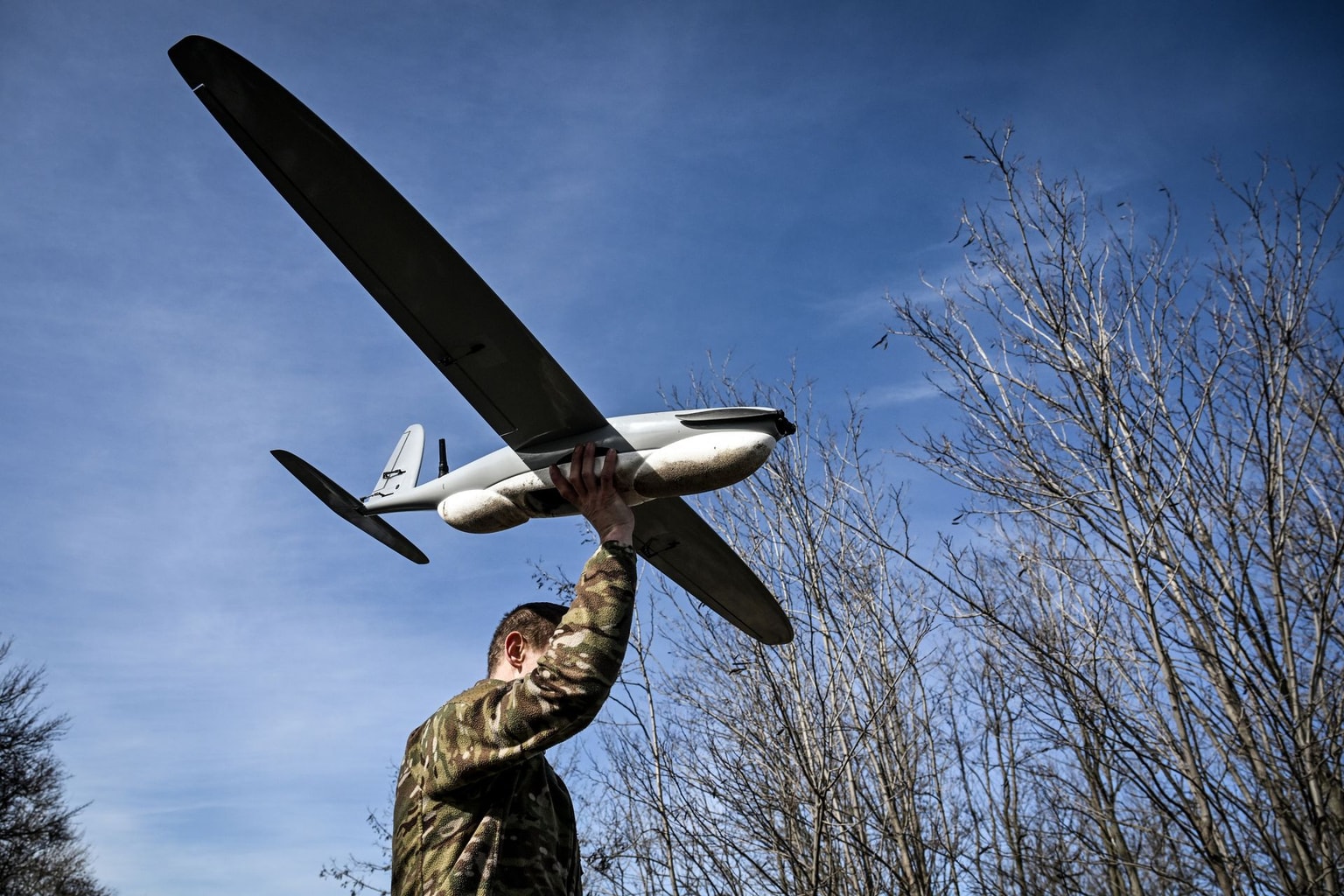
Antennas using unexplored frequencies, fiber optic cables laid out over Kherson's ruined bridges, and AI-powered modules that hone in on vehicles without a human operator, all are used to keep the human safari going.
"The enemy is refining their art," said 28-year-old jamming specialist Maksym.
"They wait on the roofs of civilian homes, on apartment buildings, on warehouses. They wait until they see someone heading down the street, and they attack."

Childhood
On a gloomy Tuesday afternoon, with the winter sun slowly setting, daily football training sessions go ahead, unbothered by sporadic artillery fire in the background.
This is Kherson’s Tavria district, the safest and liveliest part of the city. The neighborhood is just out of range of bomber drones and mortars, but is still frequented by artillery and FPVs — only fewer of them.
"The only thing that really scares me is the whir of the drones," said 13-year-old player Maksym, while his team took a break between games.
"The only thing that really scares me is the whir of the drones."
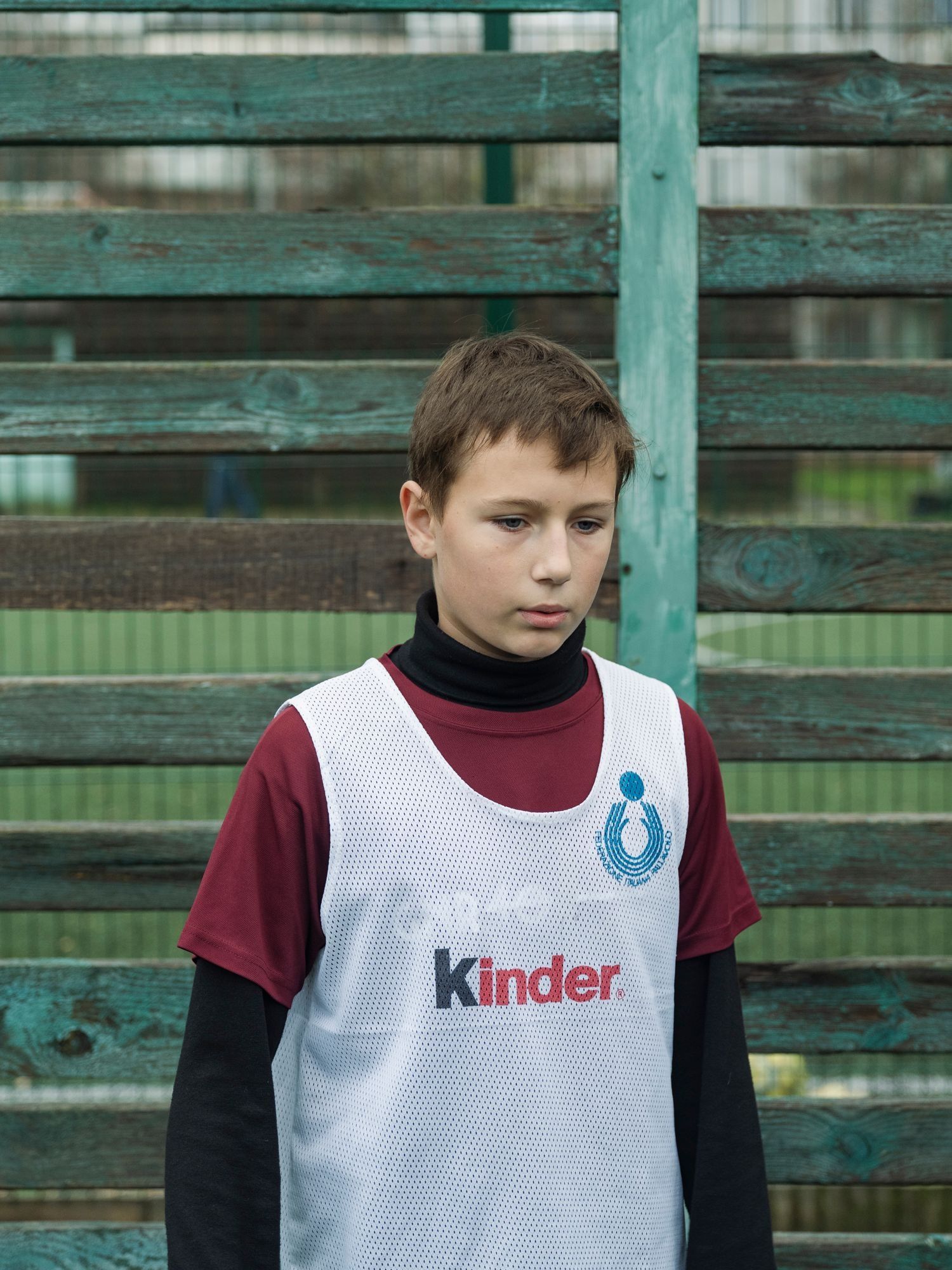
Maksym, a football player in Kherson, Ukraine on Nov. 20, 2025. (Sasha Maslov / The Kyiv Independent)
"Especially now, when there are no leaves on the trees, and there is nowhere to hide from them, only in buildings or maybe under a bench or something."
Hard-nosed local football coach Viacheslav Rol keeps his eyes glued to every movement on the pitch, barking out constant feedback in the harsh but warm way that only a career spent living and breathing sport can teach.
"If a drone comes, they run for shelter, and they laugh, 'ha ha ha'."

Football coach Viacheslav Rol in Kherson, Ukraine on Nov. 20, 2025. (Sasha Maslov / The Kyiv Independent)
Rol's sports club, Kristall, continued to train Kherson's children even under Russian occupation, and hasn't stopped since, even as Russian drones have spread out to cover the entire city.
Purpose-built out of reinforced concrete like the many others across the city, the court’s bomb shelter doubles as a changing room.
According to Rol, it is not rare for the high whir of an FPV to send his team running for cover in the middle of training.

"If a drone comes, they run for shelter, and they laugh, 'ha ha ha," he said with a wry smile. "That's the mindset here."
According to local authorities, around 5,000 children remain in Kherson.
Watching from the sidelines is 65-year-old Oleh Kachan, proud grandfather of 12-year-old Uliana, one of the top talents in Rol's girls team, which competes at the national level in their age group.
"This isn't a normal life, but football training for children is one of the ways they can have any life at all;" said Kachan, "they don't go to school, they study online, and here they can talk to each other, feel like they are part of a community."
"And the explosions? It's nothing, they hear them at home too."
Maternity
As extreme as the conditions of day-to-day life here are, Russia’s war has not stopped new Ukrainians from being brought into existence in Kherson.
At one of the city’s pre-natal centers, the courtyard is covered in dense netting,
But downstairs, in the center's refurbished basement, local mothers prepare for childbirth as they would in any peaceful city.
Thirty-two-year-old Tatiana Kuznetsova is expecting her second child after a gap of nine years, made longer due to the upheaval of occupation and war.
"Why wait for happiness?"

Tatiana Kuznetsova in Kherson, Ukraine on Nov. 19, 2025. (Sasha Maslov / The Kyiv Independent)
"Why wait for happiness?" she said, beaming. "Our older son is handling it great. If he hears a drone, he runs straight into our home or garage."
"It's a great shame, part of me wants to move, but I can't and won't leave my husband here, so we decided to stay."

Paramedic Ilona Osadcha, 31, is also expecting. But having seen what Russia's cross-river terror has brought to the region's children, she doesn't plan to raise her own in Kherson.
Speaking frantically, with exhausted eyes, Osadcha recalls responding to emergency calls after Russian attacks on her hometown of Bilozerka, just east of the city.
"I live in the red zone. I've had children die in my hands, I've held wounded children. It's very hard," she says.
"There was one child... the wounds didn't look bad, two little holes, but it was an open pneumothorax. 'Don't take big breaths, little one,' we told him, trying to calm him down. But later, in the children's hospital, he died, these two pieces of shrapnel tore up everything inside him."
"I want my child to live free in Ukraine."
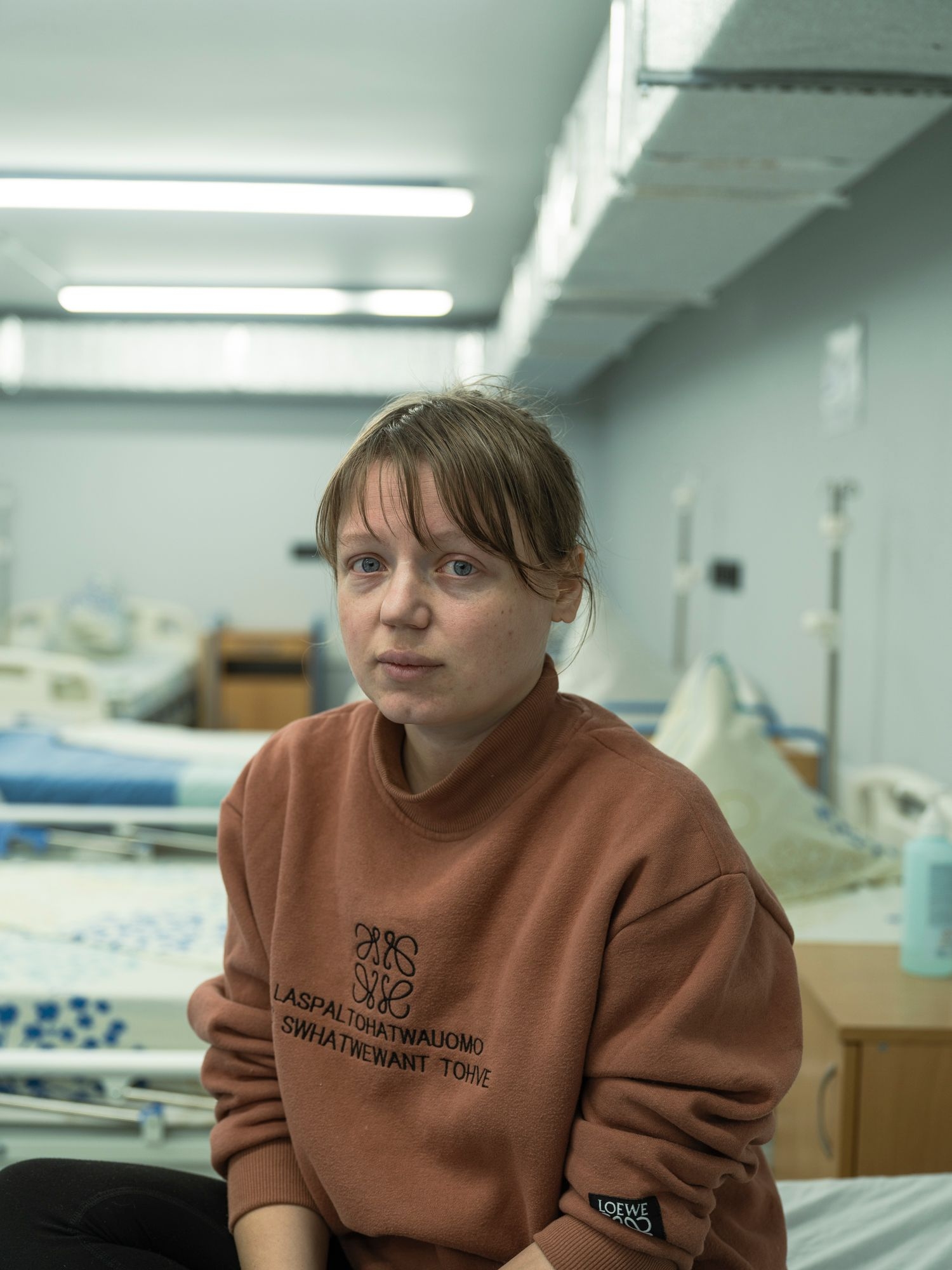
Paramedic Ilona Osadcha in Kherson, Ukraine on Nov. 19, 2025. (Sasha Maslov / The Kyiv Independent)
Staying at home with a newborn child would be egotistical, pondered Osadcha, whose husband is also a first responder. But still, she hasn't for a second considered moving abroad.
"I want my child to live free in Ukraine," she said. "I have a lot of friends who are abroad, but they were always happy here, at home."
Theater
Every day, despite the death all around them, the people of Kherson still look to find joy in the ordinary.
Braving the danger of moving around in the open, dozens of residents make their way to watch a play staged by the city’s theater.
The last play was held on the main stage on the day before the full-scale invasion, but now the theater building is closed and performances are held in a much smaller underground space.
"If I didn't have plans for the future, I wouldn't be preparing the plays of tomorrow," said theater director Oleksandr Knyha, 66, who used to live on the now-occupied eastern bank of the Dnipro.
"We cannot afford to be pessimists. I haven't lost hope that I will return to my home on the other side."
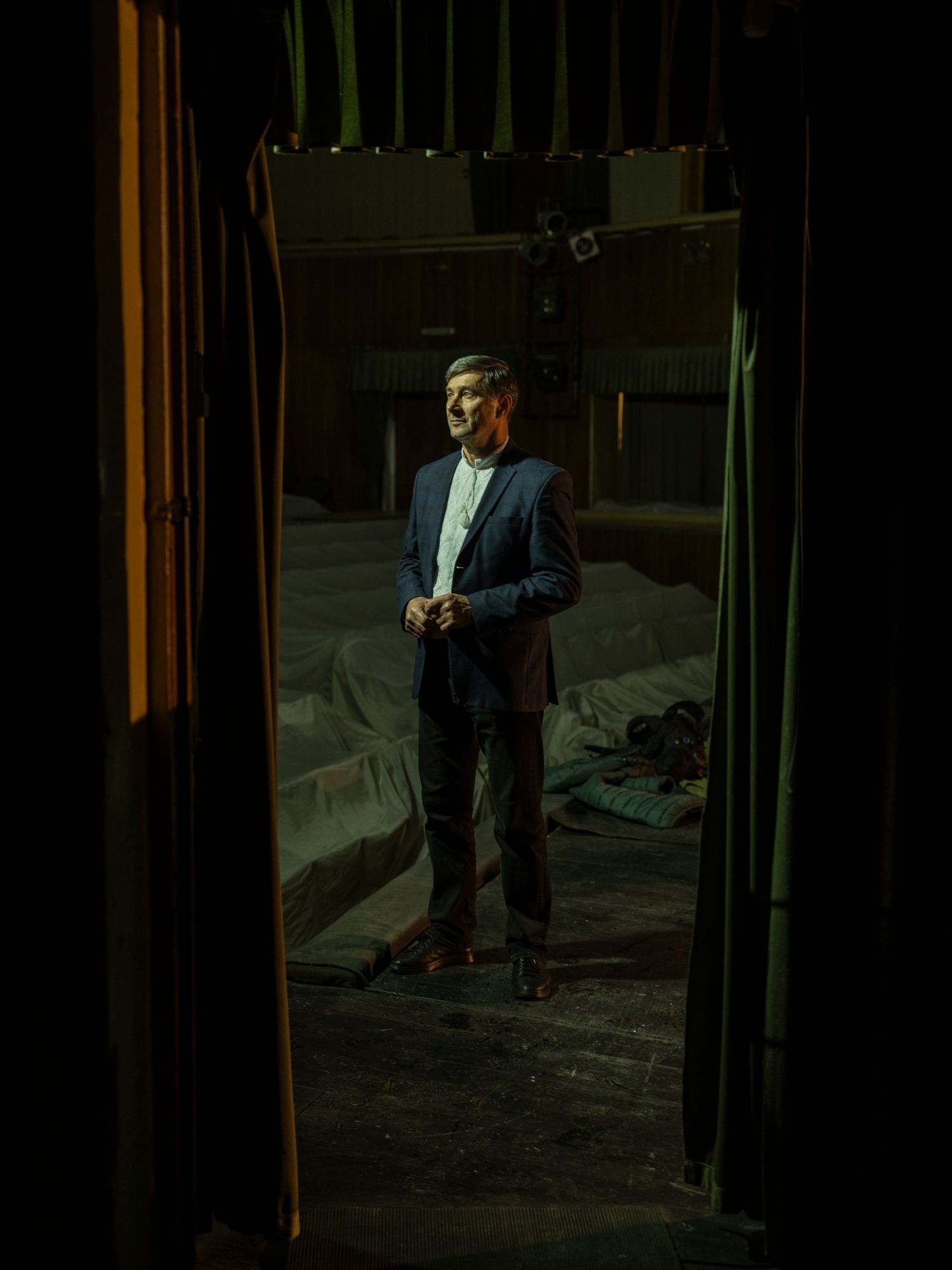
Theater director Oleksandr Knyha in Kherson, Ukraine on Nov. 20, 2025. (Sasha Maslov / The Kyiv Independent)
"We cannot afford to be pessimists. I haven't lost hope that I will return to my home on the other side.
Tonight's performance is a solo act, starring Maria Shapochka, a young actress who has arrived from neighboring Mykolaiv for the performance.
Entitled "Bird in the Attic," the work plays out as a series of video diaries of a child from Mariupol, deported and "adopted" by Russian Children's Rights Commissioner Maria Lvova-Belova, indicted by the International Criminal Court.
In an event that is both darkly bizarre and heartwarming, Kherson residents, having already been through Russian occupation and now continuing to suffer from Russia's daily hunting of civilians in their city, take time out of their day to gather just a few kilometers from Russian forces and watch a play about yet another Russian war crime.
But what on the surface might seem like grief and depression layering upon each other, in an almost masochistic act, instead becomes a source of community, a source of inner strength.


As the actor recalls the liberation of Kherson in the play, the audience watches, each recalling their own lived experience of coming out of eight months of terror.
“Kherson is Ukraine. We won't be overcome,” shouts one elderly resident at the end of the play as the small crowd rises for a standing ovation.
After the play, theatre workers and audience members mingle outside the building, chatting to Shapochka, holding a bouquet of roses, and local director Serhiy Pavliuk.
From the bag of one visitor, a local journalist, the antennas of a drone detector stick out prominently.
Just as the crowd begins dispersing, a Russian FPV drone is heard above, forcing everyone back inside until the all-clear is given. Nothing out of the ordinary for this city.
"Kherson has shown all of Ukraine and all the world how to resist," said Knyha.
"The idea of people coming out to protest against a heavily-armed aggressor and saying 'we don't want you' is difficult to understand. But these are free people."