Investigation: European companies keep the motors of Russia's war machine running
An address linked to a Russian intelligence agent in Berlin exposed a Russian business group that imports European chemicals potentially used in Russia's gunpowder production.
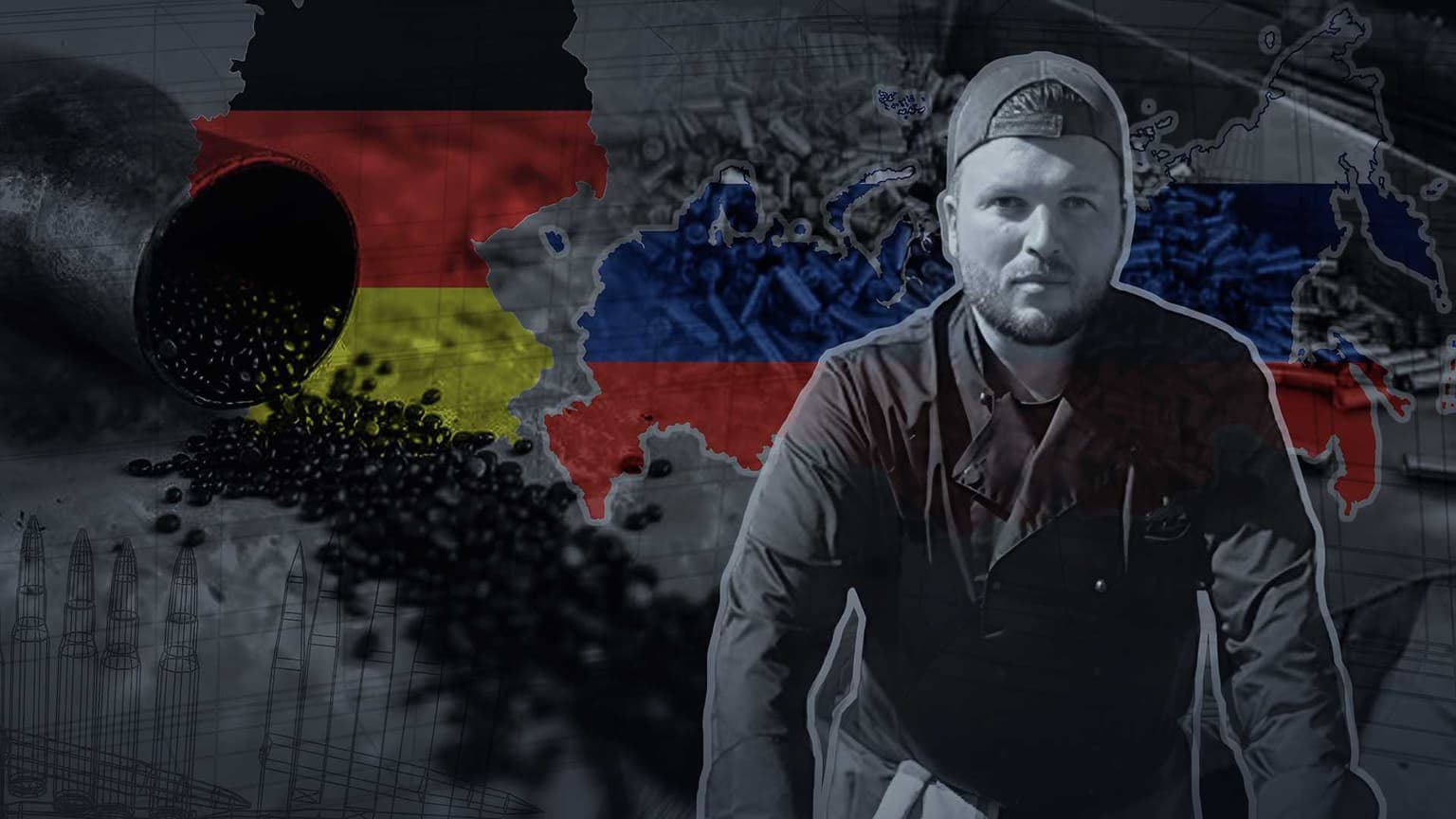
An image of Oleg Eremenko, a sanctioned Russian intelligence officer whose Berlin address was used to register B.L.W. Handel, a company tied to Delfin Group. (Photo: Desant e.V. website; Collage: The Kyiv Independent)
 on Google
Key findings:
- Since launching its full-scale invasion of Ukraine, Russia has sought supplies of motor oil additives and lubricants from third countries to maintain its military-industrial capacity and keep vehicles and heavy machinery running.
- Russian private companies continue to utilize European logistics chains to secure a steady supply of essential chemicals and components, including large volumes of glycerin routed through EU-linked intermediaries.
- The Kyiv Independent has identified a Russian petrochemical manufacturer with close ties to the military that continues to operate in Latvia and Germany, using entities and individuals sanctioned by Ukraine to help sustain imports of lubricants and glycerin into Russia.
- The company exploits loopholes in EU sanctions to keep dual-use chemicals flowing into Russia, with raw glycerin still largely unrestricted despite its potential use in propellants and explosives.
As Russia continues to wage its full-scale war against Ukraine, European supply chains are still moving industrial chemicals that help keep Russia’s machinery running and feed its war economy. One of them is raw glycerin, a common commodity that can be turned into nitroglycerin, which is used in propellants and explosives, and remains largely unrestricted under EU sanctions.
A Kyiv Independent investigation found that Russian private companies continue to use European logistics networks — a web of EU-linked intermediaries, logistics firms, and subsidiaries — to import motor oil additives, lubricants, and large volumes of glycerin into Russia. The trade, which has only grown since the full-scale war began, exposes a sanctions gap: while the EU has tightened controls on some fuel additives and lubricants, glycerin can still flow into Russia with limited scrutiny and limited transparency about military end use.
The paper trail is diffuse, spread across logistics firms, intermediaries, and holding companies, but one company's name tends to appear again and again.
Delfin Group, a Russian petrochemical manufacturer founded at the outset of the turbulent '90s, oversees a sprawling business empire. Stretching beyond the borders of Russia, Delfin has steadily extended its reach, establishing control over an intricate web of European companies.
One of those companies, based in Germany, was registered at the address of a sanctioned former Russian military intelligence (GRU) agent in Berlin, the Kyiv Independent found.
Utilizing international supply chains, the group has become one of Russia's largest importers of motor oil additives and lubricants. Its network of European entities primarily exports substantial quantities of glycerin.
Motor oils and lubricants are critical for operating the heavy machinery and vehicles Russia uses in its war against Ukraine. Following Western sanctions and Ukraine’s increasing attacks on Russia’s oil production facilities, Moscow increasingly relies on imports to make up for its domestic shortfalls.
Glycerin can be used to synthesize nitroglycerin, which is often combined with other compounds to make propellants and explosives used in ammunition — from bullets for small arms to high-calibre shells used by tanks or naval artillery.
While the EU has recently ramped up sanctions and regulatory controls on fuel additives and lubricants, raw glycerin remains a particular blind spot.
As a result, shipments of natural glycerin continue to flow freely from EU-based companies into Russia.
Based on import-export records reviewed by the Kyiv Independent, two companies stand out in the trade data: Delfin and Glycerine.ru
Petrochemical giants Delfin & Glycerine.ru
Founded in 1992 by U.S-based Boston Investment Corporation and the Moscow-registered Eenergoneftegazprom, Delfin Group is a petrochemical manufacturer largely based in Moscow. Delfin Group controls a vast web of Russian intermediaries through entities led by the Petrovsky family – Tomas Petrovsky and his son, Yanis Petrovsky.
While the group produces and licenses a wide range of products — from plastic packaging to industrial antiseptics — motor oils have been a primary focus and trademark product since its inception.
Following its success in the Russian market, Delfin expanded its network to the U.S., purchasing a former Shell Lubricants plant for $20 million in 2008. In 2012, Markos Baghdasarian, then president of Delfin Group USA, was convicted for exporting aviation engine oils and polymer valued at $850,000 to Iran. According to the U.S. Department of Justice, Baghdasarian falsified official documents by listing a UAE business as the consignee when Iranian customers were the true recipients of the goods. Delfin’s U.S. plant was later acquired by Amelie Oil in 2015.
In 2021, the Russian government reported that the Delfin Group plant near Moscow would become Russia's largest waste-oil purification facility.
Offering services such as the contract manufacturing of motor oils, Delfin has a long list of trademark oils it produces for Russian, EU and CIS markets. A number of these oils are available directly or through suppliers in the occupied regions of Ukraine.
Delfin’s growth did not halt there. Since Russia’s full-scale invasion, Delfin Distribution has been one of the leading importers of motor oil and lubricant additives in Russia. Previously relying on European suppliers to fulfill additive shipments, Delfin has since largely shifted to Asian suppliers, such as the Chinese Xinxiang Richful Lube Additive Co., Ltd. – a leading supplier of motor oil additives to Russia.

Despite Delfin Group’s shift to Asia for its supply of oil and lubricant additives, the group continues to operate in the EU. China may be one of the largest producers of oil additives for the Russian market, yet it lacks sufficient capacity to export glycerin due to domestic demand. In fact, Germany is the third largest exporter of glycerin globally, behind Brazil and Indonesia.
When it comes to glycerin imports, Delfin relies on a network of EU suppliers and subsidiaries. According to the import/export data reviewed by the Kyiv Independent, the demand for Delfin’s glycerin is growing — possibly driven by the chemical's use in the production of ammunition used by Russian forces in Ukraine.
Despite the EU sanctioning refined and distilled glycerin effective June 25, 2024, Delfin Group continues to import large quantities of natural glycerin, which can later be refined or distilled at Delfin Group's Russian production facilities.
read also
 Alisa Yurchenko
 Kateryna Denisova
Slipping through the net
There are a few major Russian players importing glycerin, purportedly for use in the civilian chemical industry. They also happen to be tied to the Delfin Group.
In 2017, Tomas Petrovsky co-founded the Russian company Glycerine Solution.
Glycerine Solution, alongside Delfin Distribution, is a key entity in the Delfin network for the receipt of glycerin imports.
Another key importer of glycerin in Russia is Tambov-based Glycerine.ru. Founded by Konstantin Pankratov and remaining under his sole ownership, the company would appear to have little to do with the Delfin Group.
Yet, there are numerous indications of cooperation between the companies. Business documents on the Glycerine.ru’s website confirm that the “full volume of glycerin that's produced by Glycerine Solution is distributed by Glycerine.ru.”

Furthermore, Glycerine.ru’s online promotional videos showcasing its production facilities heavily feature Delfin Group logos. Upon accessing Glycerine.ru's webstore, visitors are redirected to Delfin Group’s webstore, Delfin Market.
Lastly, trading data suggests a large number of glycerin imports are received by Delfin Distribution on behalf of Glycerine.ru.
Considering the evidence linking the companies, it appears that although Glycerine.ru is owned separately on paper, it functions in practice as a distributor within the Delfin Group.
More than meets the eye
Trading data suggests that since Russia’s full-scale invasion of Ukraine in 2022, both Glycerine.ru and Delfin Distribution experienced a spike in demand for glycerin. Between 2021 and 2023, Delfin Distribution’s glycerin imports shot up by 245.12%.
But what is behind this drastic increase?
An archived version of Glycerine.ru’s website showcases its advertising of glycerin use in the military industry.
As the website states, "Glycerin is used to obtain nitroglycerin, which is used to produce dynamite, smokeless powder, and other explosives for military and civilian applications. Every year, more than 40,000 tons of 98% glycerin are used worldwide to produce nitroglycerin, which represents 10% of global production. In addition, more than 7,000 tons of glycerin are used as antifreeze in various engines."

Glycerine.ru has not only advertised the military applications of glycerin. State procurement contracts dating from 2015 show that Glycerine.ru directly shipped glycerin to the Kazan Powder Plant, a state-owned explosives and munitions manufacturer in Tatarstan now under international sanctions.
The Kazan Powder Plant produces gunpowder and charges for small arms, aviation, naval, artillery, tank weapons and close combat systems. Each year, the company produces almost 70% of the total Russian volume of gunpowder and shells.
Following its invasion of Ukraine, Russia has stopped publishing data on state procurement contracts, especially those tied to its military-industrial complex. Consequently, it is impossible to verify whether Glycerine.ru or Delfin Distribution continue to supply imported glycerin to Russian gunpowder factories.
However, the activities of Delfin Group’s leaders suggest potential state and military cooperation, with indications of ties to Russian intelligence.
Delfin Aqua LLC, owned by Yanis Petrosky since 2020, was initially founded and operated under the sole ownership of the NGO Foundation "Information Service of Special Services," also known as the Information Service Foundation.
Among the foundation’s founders are several Russian state-owned entities, as well as organizations led by former intelligence officers:
- Regional Association of Veterans of Counterintelligence «Vetcon» – headed by Valentin Sobolev, an ex-KGB Officer and previous FSB Deputy Director.
- State Unitary Enterprise Main center for Special Communication, a federal state enterprise with strategic status, engaged in the delivery of secret and valuable shipments, narcotics, weapons, dangerous goods, and cash.
- Main Directorate of Special Programmes of the President of the Russian Federation (GUSP) - a federal agency responsible for mobilization in Russia, including the construction of underground fortifications to ensure the government can function under extreme conditions.
The president of the foundation, Boris Lomakin, served in the KGB of the USSR and was deputy director general of CSKA Holding.
Curiously, Delfin Aqua is not the only connection Delfin Group has with CSKA – the Central Sports Club of the Russian Army – whose primary locations are closely situated to GRU headquarters in Moscow.
On numerous occasions from December 2024 to March 2025, Peter Sorokin, chairman of Delfin's Board of Directors, has been present during the delivery of what is reported by Russian media as “humanitarian aid shipments” to the “special military operation” zone, that is, to the battlefield in Russia's war against Ukraine.

Pictured in reports are boxes plastered with Russian flags and Delfin Group logos featuring the CSKA insignia. Reports from the CSKA, local news outlets and the Governor of Kaluga, Vladislav Shapsha, celebrate their delivery of “quadrocopters (drones), electronic warfare systems, drone detectors and portable power stations.” Included in one of these shipments was Spectrol, a Delfin-licensed antigel used for improving diesel fuel performance in negative temperatures.


Other organizations involved in arranging these shipments were the United Russia Party, “Combat Brotherhood” and the CSKA Aid Foundation.
Alongside Sorokin are numerous subjects of interest, including Yuri Mironov, president of the CSKA Aid Foundation; Ildar Zainetdinov, head of the Central Headquarters for the Formation of Volunteer Battalions of the Republic of Bashkortostan; and Vsevolod Bobrov, who participated in Russia's war against Ukraine. Bobrov has been pictured with a medal often awarded to graduates of Russia’s Military-Diplomatic Academy, widely associated with GRU recruitment.

Tomas Petrovsky was also pictured alongside members of the CSKA Aid Foundation in May 2024, following their visit to the Tomb of the Unknown Soldier in preparation for Victory Day.

Pictured alongside Petrovsky (center) are founder and vice-president of the CSKA Aid Foundation, Alexander Kravtsov (right), president of the CSKA Aid Foundation, Yuri Mironov (center -right) and Executive Director of the ANO “Center for National Strategies”, Mokey Rusinov (left).
Delfin’s participation in sending supplies to the front line, ability to import dual-use chemicals and numerous connections to Russia’s military and security apparatuses suggest the group is supporting Moscow's war effort.
Controlling the flow: Delfin’s Latvian web
But who are the companies enabling this continued access to dual-use chemicals?
Vega Stividors is a Riga-based company operating in the city's freeport, a logistics hub where global supply chains converge, connecting the Americas, Northern Europe and Russia.
The company describes itself as a manufacturer of automotive oils. Its website also suggests it functions as an intermediary, organizing freight transport, storage and the handling of customs procedures. Its strategic location allows it to seamlessly organize imports and exports with Russian companies.
It happens to be one of the Delfin Group's largest trading partners. Trading data suggests the company sent tens of millions of kilos of glycerin to Russia since its invasion of Ukraine in February 2022. Most of these shipments were received by Delfin Distribution and Glycerine.ru.
Vega Stividors experienced a sudden jump in turnover coinciding with the full-scale invasion, rising from around 30 million Euros in 2021 to 41 million Euros for 2022.
Not only is Vega Stividors Delfin’s largest European trading partner. It is, as are numerous entities registered at the same address and elsewhere in Riga, under indirect control of the Delfin Group.
Vega Stividors is currently under the ownership of Ukrainian-sanctioned Sergejs Piskunovs – otherwise known as Sergej Piskunov. However, the company was under the directorship and ownership of Tomas Petrovsky from 2018 to 2020.

A similar pattern emerges upon inspection of Petrovsky’s previous directorships in Latvia, with Sergej Piskunov often becoming owner and assuming directorship of the companies.
In 2023, Latvian citizen Jeļena Rjabaja assumed directorship of many entities previously under Piskunov, including Vega Stividors. This mostly happened a few days before Piskunov was hit by Ukrainian sanctions. However, Piskunov largely maintains beneficial ownership through Cyprus-registered holding company Pavest Ltd.
Piskunov also holds beneficiary status over several companies in Ukraine, some of which are at the center of ongoing Ukrainian criminal proceedings over their alleged role in collaboration activities and financing Russia’s aggression against Ukraine. This includes the supply of products to occupied territories.
Despite Ukrainian sanctions, Tomas Petrovsky maintains direct ownership over Latvian companies Delfin Investment and Euro Delfin Industry.
Under Petrovsky’s ownership, Delfin Investment faced a public scandal during July 2019, when Latvia’s Economic Crimes Enforcement Directorate investigated the company over its potential role in laundering over €33 million. Despite an alleged attempted bribe, the company seems to have faced minimal scrutiny since then, with no reports on the matter after 2019.
These are not the only dubious financial ties Delfin’s Latvian entities possess.
The Latvian company Tilia-A, a producer of Delfin trademark motor oils, is of particular interest. Tilia-A’s last shareholder, UK-registered Cardvox, which was dissolved in 2025, had controlling partners implicated in various suspected money laundering schemes, according to media publications.
Yet, Delfin Group's entities in Latvia continue to operate with minimal scrutiny, remaining unscathed by EU sanctions. For example, in 2024, the stevedoring company
Jaunmīlgrāvja ostas kompānija completed a €1.3 million project co-financed with €583,789 from the Norwegian Financial Mechanism and public financing.
read also
Tim Zadorozhnyy Karol Luczka
Slipping through the net: German lubricants B.L.W
The Delfin Group also maintains control over a company based in Germany.
Nestled within the leafy suburbs of Berlin is B.L.W. Handel, a self-titled petrochemical manufacturer. B.L.W. functions as a logistics partner, arranging shipments of glycerin, lubricants and motor oils from producers to Russian companies within the Delfin Group network.
The company, currently under the directorship of Jeļena Rjabaja, was previously registered at the personal address of sanctioned ex-GRU Officer and representative of Officers of Russia, Oleg Eremenko, known for his ties to Berlin’s Russian House.


According to registry documents and archived websites, Eremenko had another company registered at this address, Aurus, and an organization, Desant e.V., of which he was on the board. A Moscow-based construction company, “Granat”, has also been connected to Eremenko’s personal address.
Eremenko appears in B.L.W Handel’s company documents during 2009, assuming the role of interpreter during registration and filing processes.
(Editor's note: The story has been updated to include a new detail: a surprising response to a request addressed to an alleged Russian intelligence officer. For a more detailed overview of Oleg Eremenko's role in Germany, check out Correctiv's reporting).
The Kyiv Independent sent a request for comment addressed to Oleg Eremenko to the Desant e.V.'s email. In response, the reporter received an email from a man named Wolfgang Schröder, who apparently thought he was contacting Eremenko but instead sent the email to the journalists asking about him.
The Kyiv Independent identified Schröder as the chairman of Desant e.V., and has been described by media as an alleged ex-Stasi officer.
In an email full of exclamation points, Wolfgang Schröder advises Eremenko to contact his "boss" and not disclose any information about his place of residence. In the request, the Kyiv Independent asked Eremenko about the address linking him to the Delfin Group's entity, B.L.W Handel.
Schröder's full email is provided below, translated from German:
“Hello Oleg. There is only one option for you here! Inform your boss immediately! Do not take any initiative or act on your own! Do not respond to any inquiries that have not been discussed with you! Under no circumstances should you give out any information about yourself, your former place of residence, or your current place of residence and whereabouts!!! The whole story stinks to high heaven and is obviously a deliberate provocation. Keep third parties completely out of it, except for your boss!!! With fighting greetings, Wolfgang and Gudrun."
Eremenko has not replied to the Kyiv Independent's inquiry.
Since April 2025 – four months after Eremenko was sanctioned by the EU – B.L.W. Handel has been registered at a new address. Upon visiting the location, the authors found no indication that the company maintains a physical presence at the address.

Since B.L.W.’s registration in 2007, the company has maintained close ties with Delfin Group through its directors and shareholders.
Artūrs Miscenko, the first director of B.L.W Handel, also participated in the Latvian company Vega Stividors and Euro Delfin Industry at around the same time. Miscenko presently has significant control of U.K.-registered Adelon Alliance LP, whose representatives and partners are allegedly linked to money laundering schemes and Russian intelligence operations.
From 2009 to 2012, Aleksejs Rjabijs assumed directorship of B.L.W. Handel. Rjabijs previously participated in Delfin Distribution Baltia, Delfin Investments, and Eiro Delfin Industry.
Natalia Tsareva assumed directorship of B.L.W Handel from 2012 to 2019. Tsareva was previously listed as the contact person for the Latvian company Vega Stividors.
Since 2019, B.L.W. Handel has been under the directorship of Jeļena Rjabaja, who is also a key person in Delfin Group's Latvian entities.
Under Rjabaja’s directorship, B.L.W. Handel has continued to conduct extensive trade with Russia.
From March 2023 until mid-2024, B.L.W. Handel exported nearly 1,500 tons of technical glycerin, with a customs value of 50 million rubles, according to the leaked customs records. In this same period, Vega Stividors shipped 728 tons — with an estimated customs value of 41 million rubles — on behalf of B.L.W. Handel.
B.L.W. Handel itself appears to have no capacity for industrial production. Trading data suggests B.L.W. Handel has frequently routed vast quantities of motor oils and glycerin through Latvia to be forwarded to Russia by Vega Stividors.
B.L.W. is heavily promoted as the company behind Delfin's trademarked "Kansler" motor oils and diesel products. Kansler diesel, engine oil, transmission oil, grease, and anti-freeze are currently widely available within Russia and Russian-occupied regions of Ukraine, distributed by numerous online retailers.
When the Kyiv Independent approached Jelena Rjabaja for comment, she asked for further clarification concerning facts pertaining to her role in this story, which was provided. As of publication, she has yet to provide further comment.
Putin’s pals
Both B.L.W. and Vega Stividors serve as traders for third-party producers of glycerin. Trading data shows an image of a distinct shift in the producers supplying glycerin over the past decade.
Before the full-scale invasion, Delfin’s trade route predominantly relied on producers from the U.S., Germany, Lithuania, Poland and Latvia. Since Russia’s invasion, the majority of glycerin still comes from European producers, while Brazilian producers are increasingly featured in trading data.
According to trading data, since the full-scale invasion, one of the largest suppliers of glycerin to Glycerine.ru via B.L.W. and Vega Stividors is Latvian company Bio-Venta. Between 2022 and 2023, Bio-Venta exported a total of 18,000 tons of glycerin via this route.
According to the Latvian company registry, the ultimate beneficial owner of Bio-Venta is Jānis Austriņš – son-in-law of Latvian politician and oligarch Aivars Lembergs.
Reporting has noted Austriņš’s and Lembergs’ close business associations with sanctioned Russian-Belarusian oligarch Dmitry Mazepin, former owner and CEO of Uralchem and among the businessmen who met with Vladimir Putin during the first days of the full-scale invasion. According to Reuters, Uralchem supplied chemicals to Russian ammunition manufacturers, including Sverdlov, Tambov, Kazan and Perm gunpowder plants in 2023.
When approached for comment, a spokesperson for SIA Bio-Venta replied that:
- Bio‑Venta condemns Russia’s war against Ukraine and complies with all EU, Latvian and international sanctions, emphasizing that no activities in breach of sanctions have ever taken place.
- Following EU sanctions, Bio-Venta has updated contracts with an expanded sanctions/trade-control section, while introducing a mandatory clause requiring buyers to declare that the final recipient or destination of the goods is not located in Russia or Belarus.
- Prior to Russia’s full‑scale invasion of Ukraine, SIA Bio‑Venta maintained commercial agreements that were fully lawful. Post-invasion, existing contracts were fulfilled within sanction-permitted limits.
- No new cooperation was initiated, and following the completion of prior agreements, cooperation was not extended.
The Kyiv Independent sent inquiries to all companies and individuals involved in the network, but received no other replies as of publication time.
Slippery when sanctioned
Despite numerous rounds of sanctions and export controls implemented to choke the flow of dual-use products entering Russia, the state’s military-industrial complex functions largely unabated.
EU sanctions have broadly focused on trading routes used by large private and state-owned defense enterprises. As a result, Russia’s supply network remains intact.
While targeting trade routes is important, experts have repeatedly called for closer scrutiny of the raw materials and chemicals entering Russia. With products such as glycerin, which can be used in the manufacturing of lubricants, motor oils, and ammunition, it is especially crucial that tighter restrictions are put in place.
As noted by international security expert Mariya Chukhnova, the next phase of sanctions “must strike at the raw materials that underpin Russia’s war economy — from manganese and cotton cellulose to titanium and the chemical precursors critical for explosives and aerospace manufacturing.”
Roman Steblivskyi, Director of Policy and Advocacy at the Economic Security Council of Ukraine, had this to add to the matter:
“The EU’s sanctions approach systematically leaves blind spots. The current reliance on so-called ‘targeted’ sanctions means that restrictions apply only to specific products and specific companies. This approach inevitably leaves out companies and goods with dual-use potential that are not explicitly listed”
While the EU has managed to stem the flow of motor oil and lubricant additives – crucial materials for Russia’s continued assault on Ukraine – from European manufacturers, Russian manufacturers, including Delfin, are shifting to Asian suppliers for products sanctioned by the EU.
Kristofer Harrison, Co-founder and President of non-profit Dekleptocracy, highlights the impact EU sanctions on Chinese companies could have on the Russian war effort:
“You can’t operate modern machinery without lubricants — engines, gear boxes, axles, milling equipment — anything with metal rubbing together. Their typical move for something like this (EU sanctions) is to import it from China. They've tried but can’t manufacture this at scale inside Russia.
They (Russia) cannot field a mechanised army without lubricants. No tanks. No trucks. No artillery. Sanctioning just one Chinese company would seriously harm Russia’s ability to do so. Yet, I have personally given this information to the senior-most leadership of the last two US administrations. Congress has it. We’ve delivered it to every agency in the UK and EU. Nothing.”
Small and mid-tier suppliers in both Russia and Europe also often remain unsanctioned. In the case of Delfin Group, none of its entities within Russia, Latvia, and Germany have faced sanctions from the EU. A large number of Delfin’s entities and leaders were sanctioned by Ukraine in 2023.
Without tighter EU scrutiny of chemical exports bound for Russia, loopholes are likely to keep enabling shipments that support supply chains sustaining Russia's war against Ukraine.
Inese Braze (Re:Baltica) has contributed to the story.